
Why Testing Matters
We often assume we know what motivates our donors and what message, image, or offer will inspire them to give. But the truth is, our audience’s motivations may not be what we think. That is why A/B testing is not just a marketing tactic; it is a mindset.
Testing allows your audience to tell you what they like instead of you guessing. It replaces assumptions with insights and builds confidence in decision-making. The most successful fundraisers are not the ones who have all the answers; they are the ones who are curious enough to ask the right questions through testing.
The Experiment: Multiple Angles, One Offer
In this experiment, a ministry organization set out to learn how presenting an offer in different ways might impact donations. The offer itself was simple: the organization’s annual devotional.
They created multiple versions of the same email, each focusing on a unique angle of the offer:
A testimonial from a recipient
An excerpt from the devotional
A message highlighting a matching opportunity
A version with the call-to-action at the top
A version offering multiple bundles of the devotional
They also included a standard control version with a simple image and description.
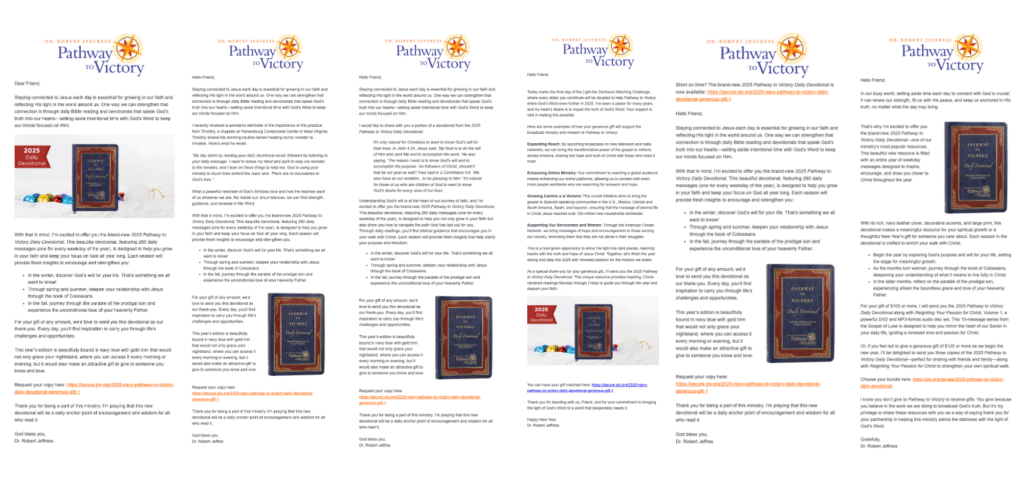
While this test had six variations (which is far more than I would recommend in nearly every situations), it was driven by curiosity to understand which motivations drive donor action.
What We Discovered
The results were surprising. Some angles that seemed most promising did not perform as expected, while others produced better-than-expected results.
And that is the beauty of testing. You often uncover insights that would have remained hidden if you had not been curious enough to test.
But here is the key: this experiment was not about “winning” or “losing” versions. It was about learning. Each version revealed something different about the audience’s interests and motivations.
Best Practices for Smart Testing
If you are inspired to start testing, here are some important guidelines to help you do it well.
1. Form a Hypothesis
Start with a clear theory about what you expect to happen and why. Think back to your middle school science experiments. The same principles apply here. Having a hypothesis helps you design meaningful tests and interpret your results with clarity.
2. Keep It Simple
Test one variable at a time such as the subject line, image, or message focus. If you change multiple elements, you will not know which one caused the difference.
3. Limit Variations
In almost every case, test only two versions (A vs. B). Only go beyond that if you have a very large audience and enough conversions to achieve valid results.
4. Ensure Even Distribution
Make sure your test audiences are balanced, not just by size, but also by engagement level, donor type (new vs. lapsed), and giving history. Each of these can influence results.
5. Run It Long Enough, But Not Too Long
A good test should run for at least one week but no more than two months. Too short and you might not collect enough data. Too long and outside factors can influence results.
6. Set a Conversion Goal
Aim for at least 50 conversions in total so that your results are based on meaningful data rather than chance. If you are testing more than two variations, you may need more conversions to achieve confidence in your results.
7. Be Curious
The best reason to test is to learn. Even if your gut tells you something will work, test it. Let your audience confirm it or surprise you.
The Takeaway
This experiment serves as a reminder that testing is about curiosity, not certainty. The goal is not just to prove your idea right but to learn something new about your audience.
That is what testing is all about: asking questions, listening to your donors, and refining your message based on real data.
So next time you are planning a campaign, ask yourself:
What do I think will work, and how can I test that to be sure?
Stay curious. Keep learning. And always be testing.
Let’s Keep Learning Together
If you have run a test that led to surprising results, I would love to see it. Or if you want to brainstorm ideas and talk through your next test, reach out and let’s chat, brittany@amplifyfr.com.
Curiosity grows stronger when we learn from each other.
