
A Digital-First New Donor Welcome Series
Built on timeliness, humanity, and real-world experience, not just automation.
By Brittany Thomas
A first-time gift is not a transaction.
It is a moment of trust, and trust is fragile.
When someone gives to your organization for the first time, they are paying attention, often more than we realize. They notice how quickly you respond. They notice whether your messages feel human or institutional. They notice whether communication feels coordinated or scattered. And they notice silence.
Whether you are starting from nothing or trying to improve something that no longer feels effective, the challenge is the same. New donors need to be welcomed quickly, clearly, and personally. Silence or generic communication costs more than most organizations realize.
This is a digital-first welcome strategy, supported by text, direct mail, paid social, and personal outreach, designed to be mostly automated while still feeling deeply relational.
Why Timeliness Is a Trust Signal
Silence after a first gift is rarely interpreted as neutrality.
For donors, the moments immediately following a gift are emotionally charged. They may feel hopeful, generous, curious, relieved, or uncertain. They have taken a step toward your organization, and subconsciously, they are waiting to see what happens next.
Timeliness is not a tactical detail. It is a relational signal.
One of the most overlooked trust moments is the online gift receipt. Too often, it is treated as an accounting artifact rather than what it actually is: the first communication a donor reads closely after giving.
A receipt that simply lists transaction details communicates efficiency, not care. A receipt that thanks the donor by name, briefly reinforces the mission, and reassures them that their gift mattered immediately reduces anxiety and builds confidence. When this moment is handled well, donors feel grounded. When it is handled poorly, doubt has room to grow.
Timeliness does not require volume. It requires intention.
Experience the Journey Before You Fix It
One of the most powerful and underused ways to improve a welcome series is to become a new donor yourself.
Not in theory. Not by reviewing a workflow. Not by looking at screenshots in a CRM.
Make a real gift.
Give online. Mail a check. Respond to a text or an ad. Then experience what happens, or does not happen, in real time.
Pay attention to the full journey. How quickly is the gift acknowledged? What does the receipt feel like? Does it sound human or transactional? Who is the sender? Which channel shows up first, and how long does it take?
Notice the gaps. Notice the overlaps. Notice the silence.
This exercise often reveals issues that are invisible on a screen. A welcome series can look thoughtful in a flowchart and still feel disjointed when emails arrive too close together, when mail lands weeks later without context, or when messages contradict one another across channels.
Real donors do not experience campaigns as assets. They experience them as moments over time.
Every Donor, Every Channel, One Welcome Experience
A common mistake organizations make is tying their welcome experience to how a donor gave instead of who the donor is.
A first-time donor is a first-time donor, whether they gave online, mailed a check, responded to a Facebook ad, attended an event, answered a phone call, or handed a donation card to a volunteer.
All of them deserve the same welcome.
This requires systems that allow every new donor to enter the same onboarding experience, regardless of entry point. Offline donors can and should be welcomed digitally once their gift is entered into the system.
When a donor mails a check and then receives a timely, warm email from a real person, it does not feel impersonal. It feels attentive. When communication is fragmented by channel, donors feel the seams.
Digital-first does not mean digital-only. It means digital sets the pace, and other channels reinforce the message.
Relationship Is Built Human to Human
One of the simplest ways to humanize a welcome series is also one of the most resisted: sending messages from people, not the organization.
Emails signed from “The Team” or “The Organization” may feel safe, but they rarely invite relationship. Messages sent from a real person, such as a development leader, executive director, or program voice, signal care and availability.
This does not eliminate automation. It reframes it.
Automation becomes a delivery mechanism for messages written as one human speaking to another. Language shifts from polished to relational, from persuasive to appreciative, from broadcast to conversation.
Tone matters. Relational communication prioritizes gratitude, curiosity, and clarity. It creates space for donors to reply and assumes someone is willing to read and respond.
Where Are Donors Experiencing Silence?
Many organizations have welcome series that look complete on paper but still fail in practice.
The problem is rarely missing emails. It is emotional gaps.
What does a donor hear in the first 24 hours after giving?
Who is listed as the sender of that message?
What happens if a gift comes in on a Friday night?
Do offline donors experience the same warmth as online donors?
Silence often hides between touchpoints, not in their absence.
The Minimum Viable Welcome
If you do not have a welcome series today, start smaller than you think.
You do not need a perfect, multi-touch, cross-channel journey to begin. You need a timely, human thank-you. You need one clear example of impact. You need a gentle invitation to stay connected.
That alone is enough to replace silence with relationship.
Doing something imperfectly is far better than doing nothing politely.
High-Touch Ideas That Make Welcome Memorable
Most welcome series fail not because they lack effort, but because they look and sound exactly like everyone else.
What makes a welcome experience memorable is not polish. It is intentional humanity.
Some organizations call every new donor. Every gift. Every channel. Every amount. A real person picks up the phone to say thank you. There is no script beyond gratitude and no ask attached. The call is brief, sincere, and deeply memorable.
Other organizations mail handwritten postcards to every new donor. Not printed handwriting or templated notes, but actual pen-to-paper messages written by staff or volunteers. The message is simple, but the effort is unmistakable.
Some invite new donors into the work early. They offer behind-the-scenes videos, staff conversations, or early access to stories not widely shared. This creates belonging before obligation.
Others use text messages not to fundraise, but to listen. A simple question asking what moved someone to give opens the door to dialogue and insight.
Some organizations intentionally delay the second ask. They choose to build confidence first, layering gratitude, education, and proof of impact before inviting another gift.
None of these approaches are about perfection. They are about presence.
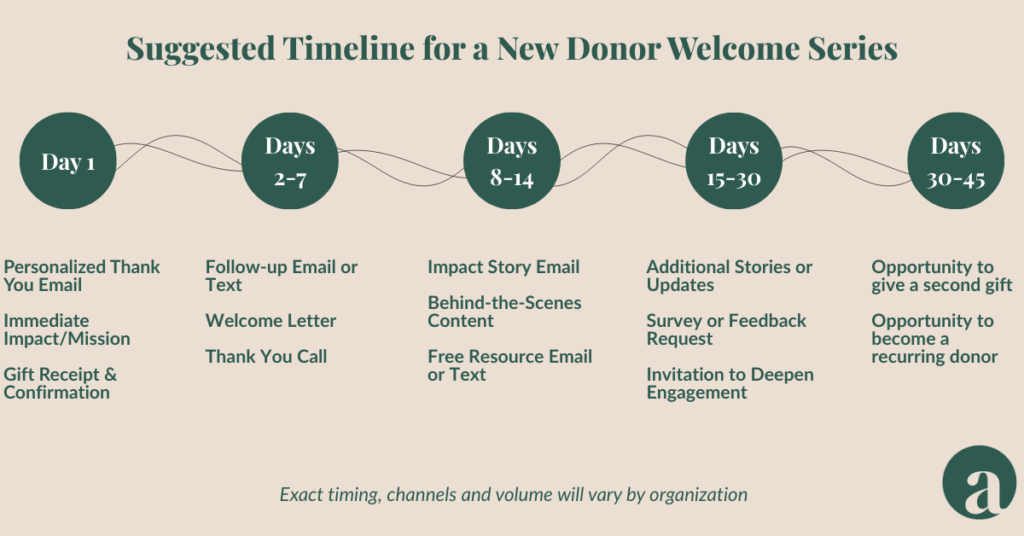
A Brief Suggested Timeline
A welcome series benefits from structure, but it should never feel rigid.
At its core, the timeline exists to ensure donors are never left wondering what happens next. Early communication should focus on acknowledgment and reassurance. The middle of the journey should deepen understanding through education and storytelling. Later touchpoints can invite a donor into a next step, whether that is continued engagement or additional support.
The exact timing, channels, and volume will look different for every organization. What matters most is the intentional progression from gratitude, to confidence, to connection.
A strong timeline leaves space for listening, avoids rushing to another ask, and ends with clarity about what the relationship will look like going forward.
Automation Without Losing Humanity
Automation does not remove responsibility. It concentrates it.
When done well, automation ensures consistency while language, tone, and timing preserve relationship. When done poorly, it amplifies distance.
Automation handles delivery. Humanity handles connection.
Measuring What Actually Matters
Second-gift conversion matters, but it is not the only signal.
Replies, survey completions, content engagement, and time to second gift all indicate whether donors feel seen, not just solicited.
Donors do not disengage because they are not generous. They disengage because they do not feel connected.
Final Thought
A welcome series is not a campaign.
It is a posture.
The first gift begins the relationship. What happens next determines whether it lasts.

Brittany Thomas
Head of Operations
Never Miss a Post!
We hope to post good and valuable content like this, without overwhelming your inbox once or twice per week. Want to be notified when a new post goes up? Complete the form below and we’ll make sure you get an email notifying you of new articles being published before anyone else gets notified.