
A Digital-First New Subscriber Welcome Series
Built on clarity, warmth, and real human connection, not just list growth.
By Brittany Thomas
When someone gives you their email address, they are not giving you permission to market to them.
They are raising their hand.
They are saying, “I’m curious.”
They are saying, “I care about this.”
They are saying, “I want to know more.”
That moment deserves more intention than most organizations give it.
Whether someone signed up for a newsletter, downloaded a resource, registered for an event, or opted to receive updates, they have taken a step toward your mission. What happens next determines whether that curiosity turns into commitment.
The goal is not just a first donation.
The goal is investment in the mission, in whatever form that takes.
This is a digital-first welcome strategy for new subscribers who have not yet given. It is supported by text, direct mail, paid social, and voice, designed to be mostly automated while still feeling deeply personal.
Why This Moment Matters More Than It Looks
It is easy to treat new subscribers as passive.
They are not donors yet. They have not taken a financial risk. They are simply names on a list.
But from their perspective, this is a decision point.
They have invited you into their inbox. They are evaluating whether you belong there.
The first messages they receive shape everything that follows. If communication feels generic, overly promotional, or disconnected from what prompted their opt-in, trust erodes quietly. If it feels clear, human, and aligned with why they signed up, trust begins to grow.
A welcome series for new subscribers is not about volume. It is about orientation.
It answers unspoken questions:
What does this organization actually do?
How do they think?
Who are the people behind this work?
Where do I fit?
Handled well, this series builds confidence before asking for commitment.
Experience the Opt-In Yourself
Before building or refining this series, sign up as if you were new.
Fill out your own form. Download the resource. Subscribe to your own newsletter.
Then wait.
What happens in the first hour? The first day? The first week?
Does the confirmation email feel warm or procedural? Does the first message acknowledge why you signed up? Does it sound like a person or a brand? Do follow-up emails assume familiarity that has not yet been earned?
If you provided a mailing address or phone number, does anything happen there? Or does that information sit unused?
Real subscribers do not experience strategy documents. They experience time, tone, and consistency.
Walk through it. Notice the gaps.
Every New Name Enters the Same Welcome
A common mistake is treating new subscribers differently based on how they opted in.
Someone who downloaded a guide receives one kind of follow-up. Someone who signed up for a newsletter receives another. Someone who attended an event is placed into a separate track.
The entry point may differ, but the core welcome should feel cohesive.
Every new subscriber should experience:
A clear introduction to the mission.
A sense of who is behind the work.
Opportunities to engage beyond reading emails.
A thoughtful path toward deeper involvement.
Personalization can acknowledge why they signed up. The foundation of relationship remains consistent.
Digital-first means email anchors the experience. Other channels reinforce it when available.
Do Not Drop New Subscribers Into General Population
One of the most common mistakes organizations make is this:
A person opts in.
They receive a confirmation email.
And within hours, they are dropped into the full stream of mass communication.
Fundraising appeals. Advocacy alerts. Event promotions. Urgent campaigns.
No context. No introduction. No welcome.
From the organization’s perspective, this feels efficient. From the subscriber’s perspective, it feels abrupt.
They have not yet learned who you are. They do not understand your tone, your priorities, or your rhythm. They have not been welcomed. They have been absorbed.
A welcome series exists to create a bridge between curiosity and belonging. If you immediately submerge a new subscriber into every message you send to long-time supporters, you remove that bridge.
The better approach is simple.
Suppress new subscribers from general communications until they complete the welcome sequence.
Let the welcome series do its work. Let it introduce the mission. Let it build familiarity. Let it create trust.
There is one important exception.
If someone explicitly opted into a specific stream, such as a newsletter, devotional, or digital resource update, honor that request. Send what they asked for. The welcome series should not override intentional consent.
But broad promotional communication can wait.
Warming before volume is not lost opportunity. It is strategic patience.
When a new subscriber completes a thoughtful welcome journey and then enters your broader communications, the messages feel familiar instead of overwhelming. They recognize your voice. They understand your work. They are more prepared to engage.
Orientation first. General population second.
Relationship before noise.
Relationship Is Built Before Revenue
It is tempting to move quickly to the first ask.
After all, this is the top of the funnel.
But urgency without orientation feels transactional.
A new subscriber needs context before commitment. They need to understand the problem your organization exists to solve. They need to see how you approach it. They need to encounter stories that make the mission human.
Revenue is a natural next step when clarity and trust are present.
Tone matters deeply here. Messages should feel like one person speaking to another. Emails should come from a real name. Invitations to reply should be genuine. If someone responds, there should be a human prepared to answer.
The goal is not to pressure. It is to invite.
Where Are New Subscribers Disengaging?
Many organizations have welcome emails in place but still see low engagement and minimal conversion.
The issue is often not frequency. It is disconnect.
Are the first emails too long? Too promotional? Too internal?
Does the subscriber understand what makes your organization distinct?
Are there clear, simple next steps to engage?
Is there space for two-way interaction?
Disengagement rarely happens in one dramatic moment. It happens quietly, when messages feel irrelevant or impersonal.
A strong welcome series reduces friction and builds momentum.
The Minimum Viable Subscriber Welcome
If you do not have a structured welcome series, start with three elements.
First, a clear confirmation and thank-you that acknowledges why they signed up.
Second, a simple introduction to the mission and what makes your organization unique.
Third, one invitation to engage, whether that is reading a story, attending an event, volunteering, sharing content, or supporting financially.
That foundation alone transforms a static list into the beginning of a relationship.
It does not need to be complex to be effective.
High-Touch Ways to Stand Out
When additional information is available, other channels can reinforce welcome in meaningful ways.
If you acquire a mailing address, consider sending a simple postcard introducing the organization and thanking them for joining the community. A tangible piece can make the relationship feel real.
If you collect a phone number, a short ringless voicemail greeting can add warmth. Hearing a real voice say, “We’re glad you’re here,” changes the tone of the relationship immediately.
Retargeting ads can reinforce mission and storytelling instead of leading with an ask. Social invitations can bring new subscribers into community spaces. Volunteer coordinators can follow up personally when someone expresses interest.
These touches do not need to be elaborate. They need to be intentional.
The goal is to make the new subscriber feel seen, not processed.
A Brief Suggested Timeline
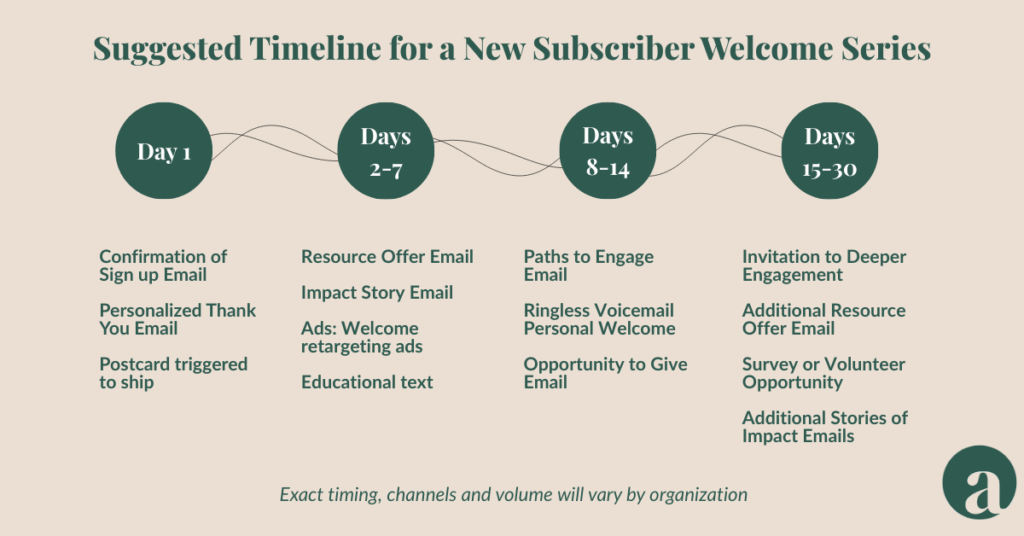
A subscriber welcome series benefits from structure, but it should never feel rushed.
Early messages should focus on confirmation and orientation. The middle of the series should deepen understanding through stories, education, and clear explanations of impact. Later touchpoints can introduce opportunities for involvement, including financial support, volunteering, advocacy, or sharing the mission with others.
The progression matters more than the volume.
Move from curiosity to clarity.
From clarity to connection.
From connection to commitment.
Each step should feel earned.
Automation Without Losing Intention
Automation ensures consistency. It does not replace responsibility.
When built thoughtfully, automation delivers timely, relevant communication that feels personal. When built carelessly, it amplifies noise.
Every automated message should read as if someone sat down to write it to one person. Because in reality, that is exactly what is happening.
Automation handles delivery. Intention handles relationship.
Measuring What Actually Signals Growth
Open rates matter. Click rates matter. Conversion to first gift matters.
But so do replies. Event registrations. Volunteer inquiries. Content consumption. Time between opt-in and first action.
Engagement is a spectrum, not a single outcome.
A strong welcome series expands the ways someone can invest in the mission. Financial support is one expression of belief. It is not the only one.
When subscribers feel informed, valued, and connected, giving becomes a natural extension of involvement.
Final Thought
An email address is not a lead.
It is a person.
They have taken a small step toward your mission. Your welcome determines whether that step becomes momentum.
A subscriber welcome series is not about moving someone quickly to a transaction.
It is about guiding someone thoughtfully into relationship.
And relationship, built with care, sustains everything that follows.

Brittany Thomas
Head of Operations
Never Miss a Post!
We hope to post good and valuable content like this, without overwhelming your inbox once or twice per week. Want to be notified when a new post goes up? Complete the form below and we’ll make sure you get an email notifying you of new articles being published before anyone else gets notified.